Gamma-ray burst afterglows · outflow geometry
Afterglows know the outflow
is not a sphere.
They do not generically know it is a jet.
Marcus DuPont · Princeton University
Lyman Spitzer Jr. Fellow · Future Faculty in the Physical Sciences Fellow
Rise_Time 2026 · Purdue University · August 13th, 2026
The canonical picture
A compact engine launches a narrow relativistic jet
1 · Launch
Energy is collimated into two polar cones.
2 · Decelerate
The forward shock sweeps up the ambient medium.
3 · Break
The light curve steepens when the edge becomes visible and lateral evolution matters.
What the data actually establish
The jet break is an argument against sphericity
steeper than
spherical
⇒ the emitting outflow has angular structure
Common inference
aspherical ⇒ jet
Logically allowed inference
aspherical ⇒ not unique
The inverse problem
One unresolved light curve compresses many physical dimensions
1Choose an angular structure ε(θ, φ)
2Evolve the outflow and its emission
3Integrate the unresolved image into Fν(t)
many outflows
↓
one curve
Geometry is inferred through a model family.
A counterexample is enough
Replace the polar cap with an equatorial band
Sphere
two spreading dimensions
Jet
localized in both angular dimensions
Ring
localized in one angular dimension
All three can drive synchrotron afterglows. Two are aspherical.
DuPont, MacFadyen & Sari · ApJ 957, 29 (2023)
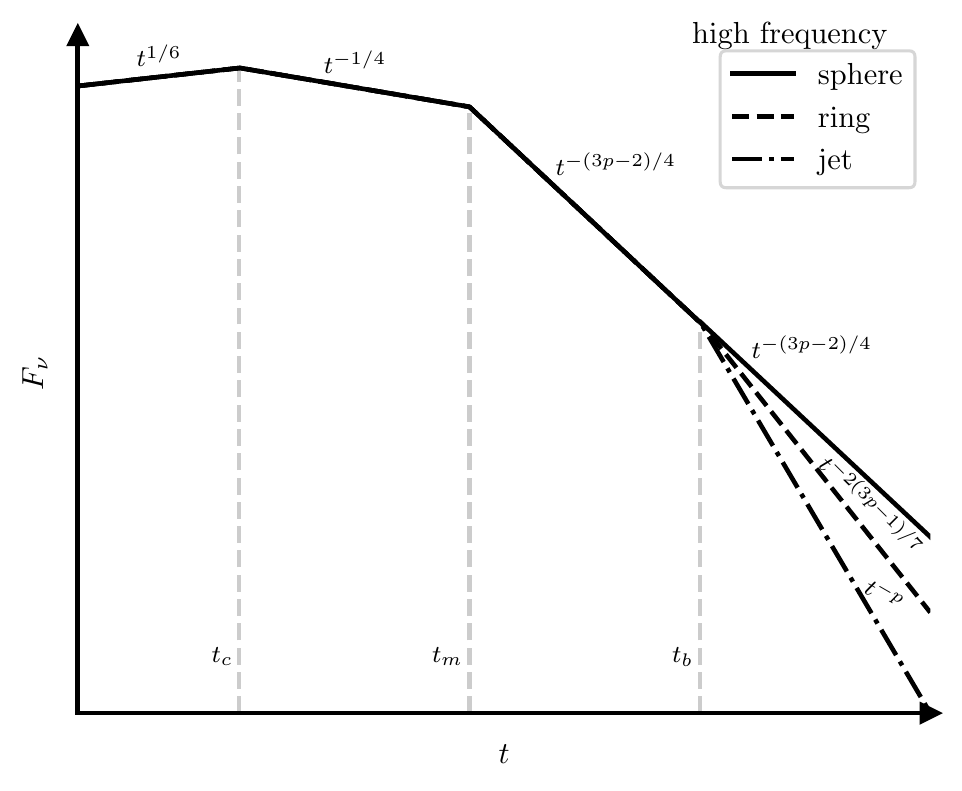
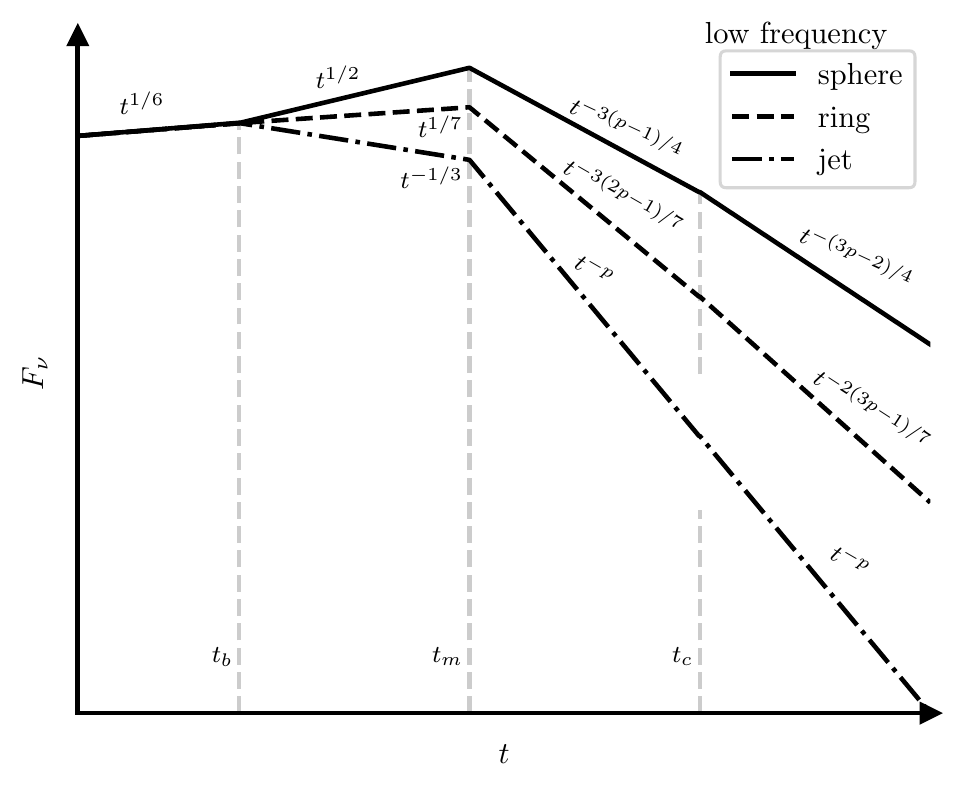
Rings occupy the missing dynamical middle
Sphere
slowest
late-time decay
Ring
between
sphere and jet
Jet
fastest
late-time decay
A steepening light curve does not select a unique angular topology.
An existence proof nearby
The Crab channels wind power toward its equator
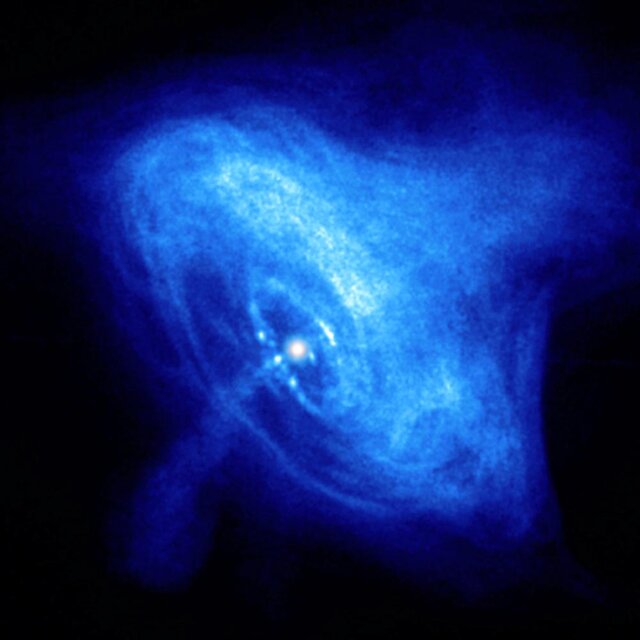 Chandra X-ray image · NASA/CXC/ASU/J. Hester et al.
1The X-ray torus and moving wisps trace an equatorial termination shock.
2IXPE finds a predominantly toroidal magnetic field near the pulsar.
3Striped-wind models place relativistic reconnection — and potentially pulsed γ-rays — in the equatorial current sheet.
This is not a GRB ring. It is evidence that rotating neutron stars naturally make energetic equatorial structures.
Weisskopf et al. 2000 · Cerutti & Philippov 2017
Mizuno et al. 2023 · Temim et al. 2024
Order-of-magnitude check
A millisecond magnetar can easily power a ring
Rotational reservoir
Erot = ½IΩ²
2 × 1052
erg for I=1045 g cm², T=1 ms
Dipole spin-down
Lsd ∝ B²T−4
1049
erg s−1, lasting ∼2 × 10³ s for B=1015 G
Only 10% required
Ering = feqErot
2 × 1051
erg for feq=0.1
The difficult question is geometry and baryon loading — as opposed to, say, the energy reservoir.
Thompson, Chang & Quataert 2004 · Spitkovsky 2006
A geometric prior from pulsar winds
Pulsar winds are equatorially weighted
Split-monopole scaling
dL/dΩ ∝ sin²θ
The power per solid angle peaks in the rotational equator.
Power inside an equatorial wedge
feq(Δ) = ³⁄₂[sin Δ − ⅓ sin³Δ]
26%
within ±10° of the equator
Eeq ≈ 5 × 1051 erg for a 1 ms magnetar — before invoking any extra focusing.
Split-monopole estimate; equatorial current-sheet width and conversion to bulk kinetic energy remain model dependent.
A concrete laboratory
GW170817 gave us more than a light curve
Iν(x, y, t)
image size & morphology
Every resolved observable returns information discarded by the integrated flux.
DuPont & MacFadyen · ApJL 971, L24 (2024)
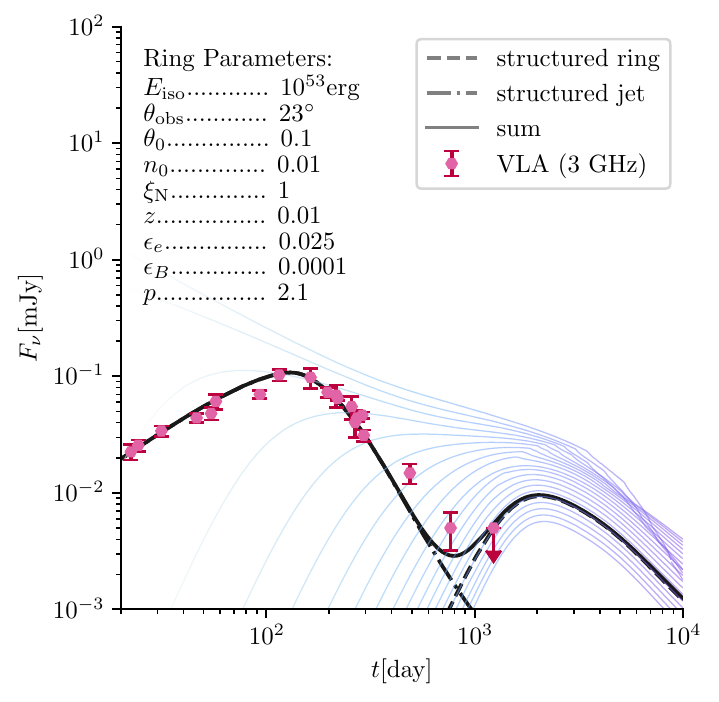
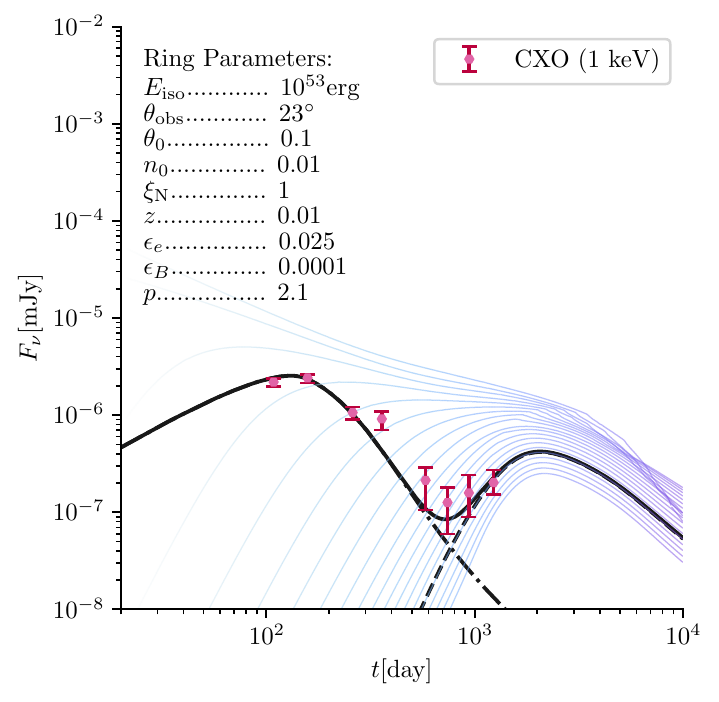
A powerful ring can be hidden in plain sight
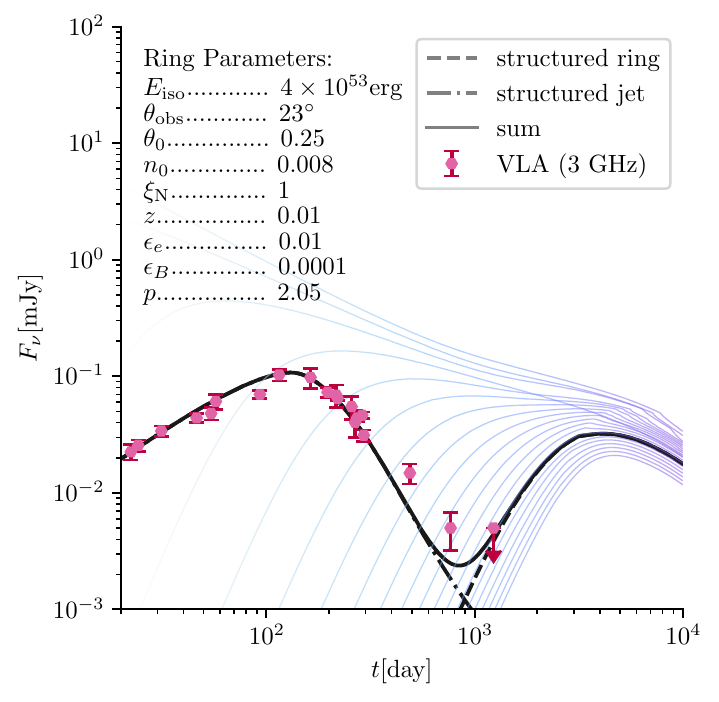
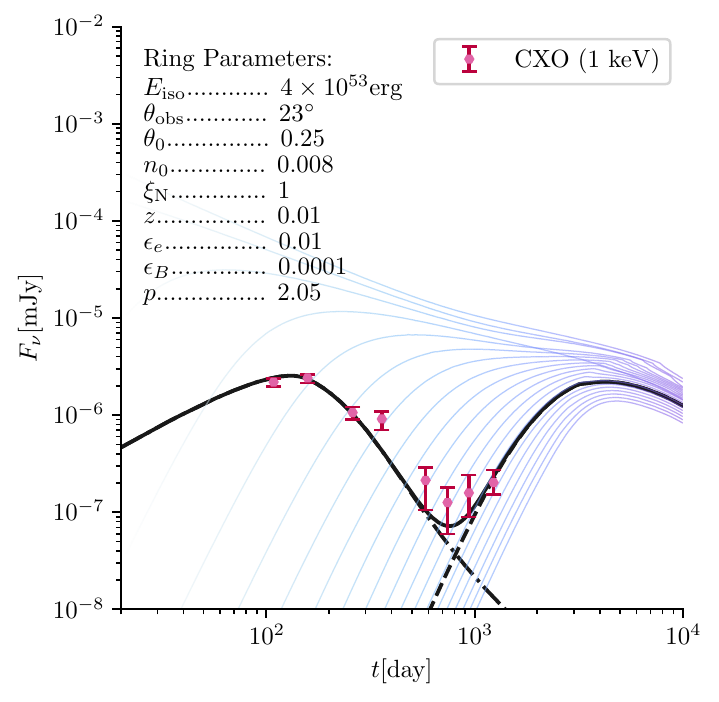
1A long-lived merger remnant launches a relativistic equatorial outflow.
2Relativistic beaming points its emission away from Earth.
3As the ring decelerates, its beaming cone widens into our line of sight.
4Late-time rebrightening.
One engine · two angular components
Imagine a long-lived remnant launching both a jet and a ring
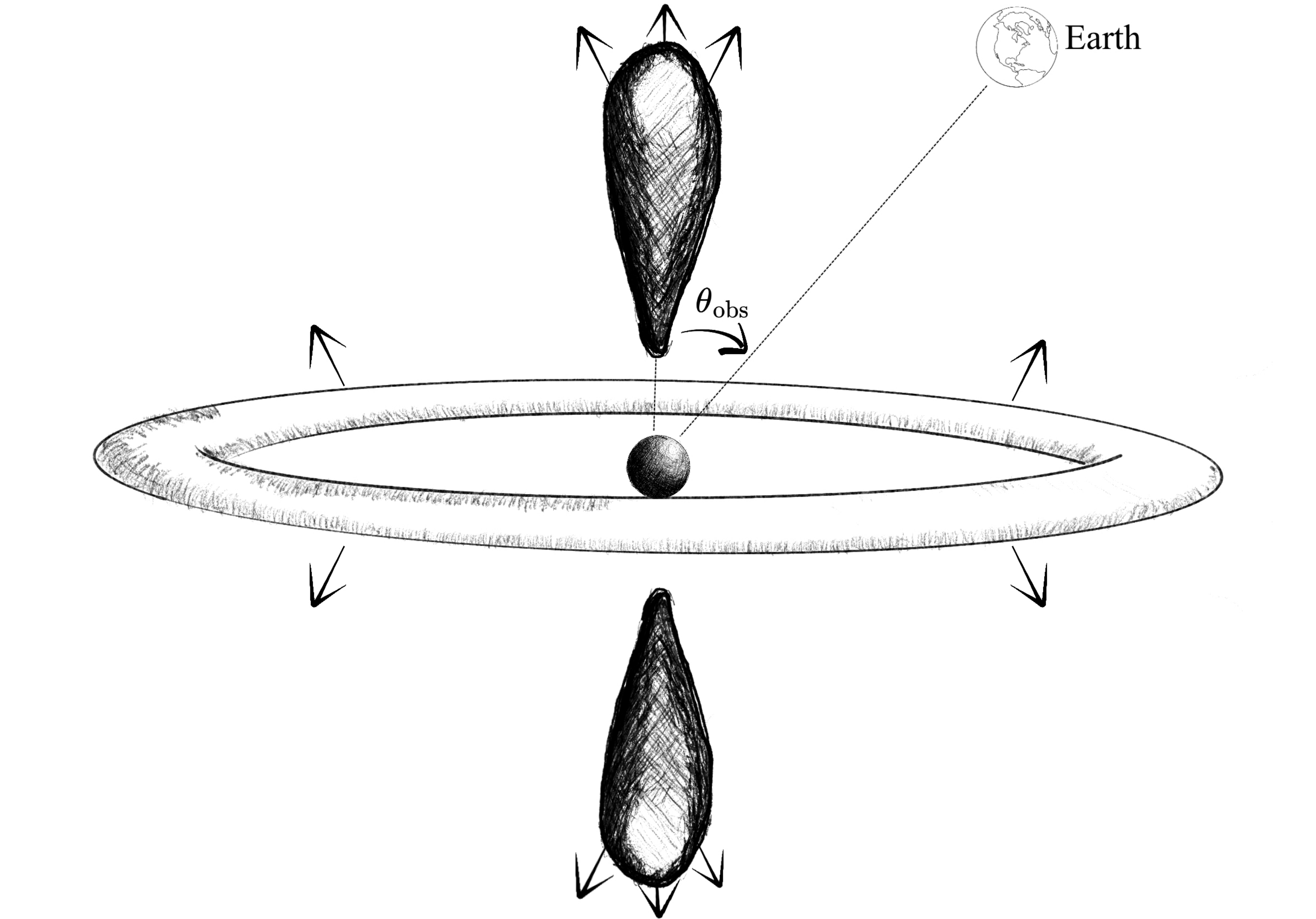
The polar component can dominate first.
The equatorial component can carry comparable energy while remaining beaming-hidden.
The afterglow need not originate from a single angular component.
DuPont & MacFadyen 2024 · geometric schematic

DuPont, in prep. · GW170817-scaled BMK-sector images · top-hat profiles · VLBI constraints from Mooley et al. 2018, 2022

DuPont, in prep. · GW170817-scaled BMK-sector images · Gaussian profiles · VLBI constraints from Mooley et al. 2018, 2022
What would actually constrain geometry?
Move from a scalar time series to a resolved, multi-messenger test
Integrated observables
- multi-band temporal slopes
- spectral breaks and polarization
- late-time calorimetry
Spatial + external information
- centroid motion and reversals
- image size, axis ratio, morphology
- GW inclination / host constraints
A geometric claim should survive observables that retain angular information.
Take-home message
Afterglows robustly tell us
the outflow is aspherical.
Calling it a jet requires
additional assumptions — or data.
Rings are not the answer to every burst.
They simply argue that the answer is not unique.
Discussion
Which observation would make you believe the geometry?
On the Theory of Ring Afterglows
DuPont, MacFadyen & Sari · ApJ 957, 29 (2023) · arXiv:2304.00044
Did Binary Neutron Star Merger GW170817 Leave Behind a Long-lived Neutron Star?
DuPont & MacFadyen · ApJL 971, L24 (2024) · arXiv:2405.20329
Questions?