Perturbation Theory for
Binary Bondi Accretion
Marcus DuPont
Princeton University
RIKEN iTHEMS — Kobe, Japan 2026


Roadmap
- Bondi Accretion — the single-body problem
- From One to Two — introducing a binary
- Perturbation Theory — the master ODE
- The Sonic Point — Frobenius theory
- Global Solution — matching regions
- The Answer — second-order accretion rate
- Simulations — where the theory breaks
I. Bondi Accretion
Spherical accretion onto a single mass
The Physical Picture
A mass $M$ embedded in a uniform gas at rest
Density $\rho_\infty$, sound speed $c_\infty$
Gas falls inward, accelerates, crosses the sonic surface
Bondi (1952) — how fast does a star accrete from the interstellar medium?
The simplest model of gravitational accretion. Exact, analytic, and the foundation for everything that follows.
The Governing Physics
Steady, spherically symmetric flow — two conservation laws and an equation of state:
Mass conservation
$$\dot{M} = 4\pi r^2 \rho\, v = \text{const}$$
Bernoulli integral (energy conservation along streamlines)
$$\frac{1}{2}v^2 + \frac{c^2}{\gamma - 1} - \frac{GM}{r} = \frac{c_\infty^2}{\gamma - 1}$$
Isentropic EOS: $p = K\rho^\gamma$, sound speed $c^2 = \gamma\, p/\rho$
The Bondi Radius
Where does gravity win over thermal pressure?
For $r \ll R_B$: gravitational energy dominates — gas is captured
For $r \gg R_B$: thermal pressure supports the gas — negligible infall
The Bondi accretion rate:
$\lambda(\gamma)$ is a dimensionless constant fixed by the transonic condition
The Critical Point
The $(r, u^2)$ phase plane has a saddle point at $r = R_s$, $u^2 = c_s^2$
Six families of solutions, but only two — the separatrices — pass through the saddle
The accretion branch: subsonic at $\infty$, supersonic near origin
The wind branch: the reverse (Parker wind analog)
All other curves miss the saddle: subsonic, supersonic, or double-valued
Requires $\gamma < 5/3$ for finite sonic point. The accretion rate $\dot{M}_B$ is selected by the transonic condition.
Why This Matters for Perturbation Theory
Structural stability of the saddle: Small changes to the equations shift the saddle but do not destroy it. A transonic solution still exists.
The accretion rate is set by the transonic condition
→ The first-order correction to $\dot{M}$ vanishes — the leading change is second order in the perturbation
At the sonic point:
$$v_r(R_s) = c_r(R_s) \equiv c_s, \qquad c_s^2 = \frac{1}{2R_s}$$II. From One to Two
Splitting the single accretor into a binary
Binary Setup
Circular binary: total mass $M$, separation $a$, mass ratio $q = M_2/M_1$
Key scale hierarchy:
$$\xi \equiv \frac{R_B}{a} = c_\infty^{-2} \gg 1$$Binary orbits deep within the collective Bondi sphere
Reduced mass parameter:
$$\mu \equiv \frac{q}{(1+q)^2}, \quad 0 < \mu \leq \tfrac{1}{4}$$Three Regimes of Binary Accretion
The binary introduces a new length scale $a$. Relative to the Bondi radius $R_B$:
$$\xi \ll 1$$
$a \gg R_B$
Binary separation exceeds the Bondi radius. Each mass accretes independently — two separate Bondi spheres.
$$\xi \sim 1$$
$a \sim R_B$
Binary separation comparable to Bondi radius. Fully nonlinear — no small parameter, requires numerical treatment.
$$\xi \gg 1$$
$a \ll R_B$
Binary deep within its collective Bondi sphere. Flow sees a monopole $+$ small multipole corrections. Perturbation theory applies.
This talk: $\xi \gg 1$ — a single Bondi sphere with a perturbatively small quadrupole.
Visualizing the Three Regimes
$\xi \ll 1$
Independent accretion
$\xi \sim 1$
Fully nonlinear
$\xi \gg 1$
Monopole + perturbation
The Binary Potential
Multipole expansion of the two-body potential:
Monopole $+$ quadrupole correction. No dipole (center-of-mass frame).
Full time-dependent form includes an $m=2$ rotating piece:
$$\Phi = -\frac{1}{r}\!\left\{1 + \frac{\mu}{2r^2}\!\left[P_2(\cos\theta) + \tfrac{3}{2}\sin^2\!\theta\cos 2(t-\phi)\right]\right\}$$Time Averaging
Compare the orbital frequency $\Omega = 1$ to the acoustic response at the sonic surface:
$$\omega_{\mathrm{ac}} \sim \frac{c_s}{R_s} \sim \xi^{-1}$$Since $\Omega/\omega_{\mathrm{ac}} \sim \xi \gg 1$, the subsonic flow sees a time-averaged potential:
Monopole $+$ static axisymmetric quadrupole
What Is the Expansion Parameter?
Not $\mu$ — equals $1/4$ for equal masses, need not be small
Not $\mu/r^2$ — depends on position, not a parameter
The accretion rate is set at the sonic surface $r = R_s$.
The self-consistency parameter:
For $\xi \gg 1$, this is small regardless of $\mu$.
No separate requirement that the mass ratio be extreme.
III. Perturbation Theory
Linearization and the master ODE
Qualitative Structure Before Calculating
Geometry of $P_2$
Effective gravity enhanced along axis, reduced equatorially
Sonic surface deforms into a prolate shape
First-order $\dot{M}$ vanishes!
Every correction $\propto P_2(\cos\theta)$
$$\int_{-1}^{1} P_2(x)\,dx = 0$$Orthogonality of $P_2$ to the monopole
The Prediction
Two independent arguments (orthogonality + saddle stability) give:
The leading correction is quadratic in $\varepsilon_s$.
Computing this requires the explicit first-order solution.
Potential Flow Formulation
The Bondi background is spherically symmetric and irrotational.
Write the velocity field as a gradient: $\mathbf{v} = \nabla\chi$
Bernoulli integral
$$\frac{1}{2}|\nabla\chi|^2 + \frac{c^2}{\gamma - 1} - \frac{1}{r} = B_0$$
Mass conservation
$$\nabla\cdot(\rho\,\nabla\chi) = 0$$
Two equations for $\chi$ and $\rho$ — this is the system we perturb.
The Perturbative Expansion
How does the binary modify this potential flow? Expand about the Bondi solution:
$$\chi(r,\theta) = \chi_0(r) + \varepsilon_s\,\chi_1(r,\theta) + \varepsilon_s^2\,\chi_2(r,\theta) + \cdots$$
$$\rho(r,\theta) = \rho_0(r) + \varepsilon_s\,\rho_1(r,\theta) + \varepsilon_s^2\,\rho_2(r,\theta) + \cdots$$
$$c^2(r,\theta) = c_0^2(r) + \varepsilon_s\,c_1^2(r,\theta) + \cdots$$
Zeroth order $(\chi_0, \rho_0, c_0)$ = the Bondi solution from Part I. Each correction breaks spherical symmetry via $\theta$-dependence.
Linearization
Expand about Bondi: $\chi = \chi_0 + \chi_1$, $\rho = \rho_0 + \rho_1$
Separation of variables is exact:
Background is spherically symmetric $\Rightarrow$ each $\ell$ decouples
From the linearized Bernoulli equation, density is determined algebraically by $\mathcal{R}'$:
$$\rho_1 = \frac{\mu\rho_0}{c_0^2}\!\left(\frac{1}{2r^3} + v_0\mathcal{R}'\right)P_2$$One dynamical degree of freedom.
The Master ODE
Eliminate $\rho_1$ between Bernoulli and continuity:
$$\alpha_1 = v_0'\!\left(\gamma v_0 + \frac{c_0^2}{v_0}\right) - \frac{2(\gamma\!-\!1)v_0^2}{r}$$
$$\sigma = -\frac{v_0}{2r^3}\!\left[\frac{(5\!-\!2\gamma)v_0}{r} - (\gamma\!-\!1)v_0'\right]$$
The operator on the left is universal — depends only on the Bondi background.
Only $\sigma(r)$ encodes the binary quadrupole source.
IV. The Sonic Point
Regular singular point and Frobenius theory
The Singular Coefficient
The leading coefficient $\alpha_2(r) \equiv v_0^2 - c_0^2$ vanishes at $r = R_s$
$r > R_s$: subsonic, elliptic
boundary data at $\infty$ propagates in
$r < R_s$: supersonic, hyperbolic
information flows only inward
$r = R_s$: degenerate — the equation is singular
Regular Singular Point
Since $\alpha_2 \propto (r - R_s)$ near the sonic point, define $\zeta = r - R_s$:
$$\mathcal{R}'' + \frac{p(\zeta)}{\zeta}\mathcal{R}' + \frac{q(\zeta)}{\zeta}\mathcal{R} = \frac{s(\zeta)}{\zeta}$$where $p$, $q$, $s$ are all analytic at $\zeta = 0$
This is a regular singular point — the singularity is as mild as possible
Ordinary power series assume analyticity — they diverge here. WKB assumes slowly-varying coefficients — but $R_s$ is where they change sign. Numerics lose precision at the singularity.
Frobenius theory is built for exactly this situation.
Frobenius Solutions
Substitute $\mathcal{R} = \zeta^s\sum c_n\zeta^n$ — the leading power $\zeta^{s-2}$ gives the indicial equation:
One verifies $A > 1$ for all $\gamma \in (1, 5/3)$
Two roots:
Regular: $s_1 = 0$
$\mathcal{R}^{(\mathrm{reg})} = 1 - \frac{B}{A}\zeta + \cdots$
Bounded at $R_s$
Singular: $s_2 = 1 - A < 0$
$\mathcal{R}^{(\mathrm{sing})} = |\zeta|^{1-A} \to \infty$
Blows up at $R_s$
The Regularity Condition
A physical perturbation must pass smoothly through the sonic surface.
The coefficient of $\mathcal{R}^{(\mathrm{sing})}$ must vanish.
This is the perturbative analog of the saddle-point condition:
Just as the unperturbed flow threads the saddle along the separatrix, the perturbation must remain tangent to the transonic branch.
Counting conditions: 2nd-order ODE, two conditions:
1. Decay at infinity: $\mathcal{R}(\infty) = 0$
2. Regularity at $R_s$
→ Unique solution
V. Global Solution
Matching local solutions across regions
Three Regions
No single representation is valid everywhere.
Construct local solutions and match in the overlap.
Far Field: Euler Equation
For $r \gg R_s$: $v_0 \ll c_0$, coefficients become power laws
Homogeneous solutions: $r^2$ (growing) and $r^{-3}$ (decaying)
Boundary condition $\mathcal{R}(\infty) = 0$ kills $r^2$. Variation of parameters gives:
$$\mathcal{R}_{\mathrm{out}}(r) = C_- r^{-3} + \mathcal{R}_{\mathrm{out}}^{(p)}(r)$$$C_-$ determined by matching to the Frobenius solution
Below the Sonic Point: Exponential Decay
For $r < R_s$, $\alpha_2 > 0$: the equation is hyperbolic.
A Liouville transformation $\mathcal{R} = w(r)\,u(r)$ eliminates the first derivative, giving $\alpha_2\,u'' + Q(r)\,u = \tilde{\sigma}$ with $Q > 0$. WKB gives:
Physical interpretation: In supersonic flow, acoustic signals cannot propagate upstream. The perturbation is swept inward and exponentially suppressed.
$\mathcal{R}(r \sim a) \sim e^{-\#\xi} \approx 0$
The perturbation theory is never tested where it might fail.
VI. The Physical Answer
Second-order accretion rate
Sources of Second-Order Flux
At $\mathcal{O}(\mu^2)$, three contributions to $\dot{M}$:
(a) Cross terms — products $\rho_1 \times \partial_r\chi_1$ on the unperturbed sphere
(b) Surface deformation — first-order fields on the $\mathcal{O}(\mu)$-deformed surface
(c) Second-order monopole — $P_2 \times P_2$ generates $P_0$:
$[P_2(x)]^2 = \tfrac{1}{5} + \tfrac{2}{7}P_2(x) + \tfrac{18}{35}P_4(x)$
The cross-term angular integral $\int [P_2]^2\,d\Omega = 4\pi/5$ does not vanish!
The Result
Restoring definitions:
$$\frac{\Delta\dot{M}}{\dot{M}_{\rm Bondi}} \sim \frac{\mu^2}{R_s^4} = \frac{q^2}{(1+q)^4}\left(\frac{5-3\gamma}{4}\right)^{\!-4}\xi^{-4}$$The Result
Why $\varepsilon_s^2$, not $\varepsilon_s$?
First-order vanishes by $\langle P_2, P_0\rangle = 0$
Structural stability of the saddle: $\dot{M}$ is stationary
Sign: $\mathcal{C} > 0$
The binary enhances accretion
$P_2$ deformation increases sonic surface area:
$A = 4\pi + \tfrac{8\pi}{5}\varepsilon^2 + \cdots$
Numerical Estimate
AGN binary: $M = 10^8 M_\odot$, $c_\infty = 10$ km/s, $a = 0.01$ pc, $\gamma = 4/3$
$$\xi = \frac{GM}{c_\infty^2 a} \approx 300$$
$$R_s = \frac{\xi}{4} = 75, \qquad \varepsilon_s = \frac{1/4}{2 \times 75^2} \approx 2\times 10^{-5}$$
$$\frac{\Delta\dot{M}}{\dot{M}_{\rm Bondi}} \sim \varepsilon_s^2 \approx 4\times 10^{-10}$$
The Bondi sphere does not "know" whether its central mass is a single object or a binary.
VII. Simulations
Where the theory meets the code
The Isothermal Case: Theory on the Right Track
$\gamma = 1$, $\xi = 10$: deep perturbative regime
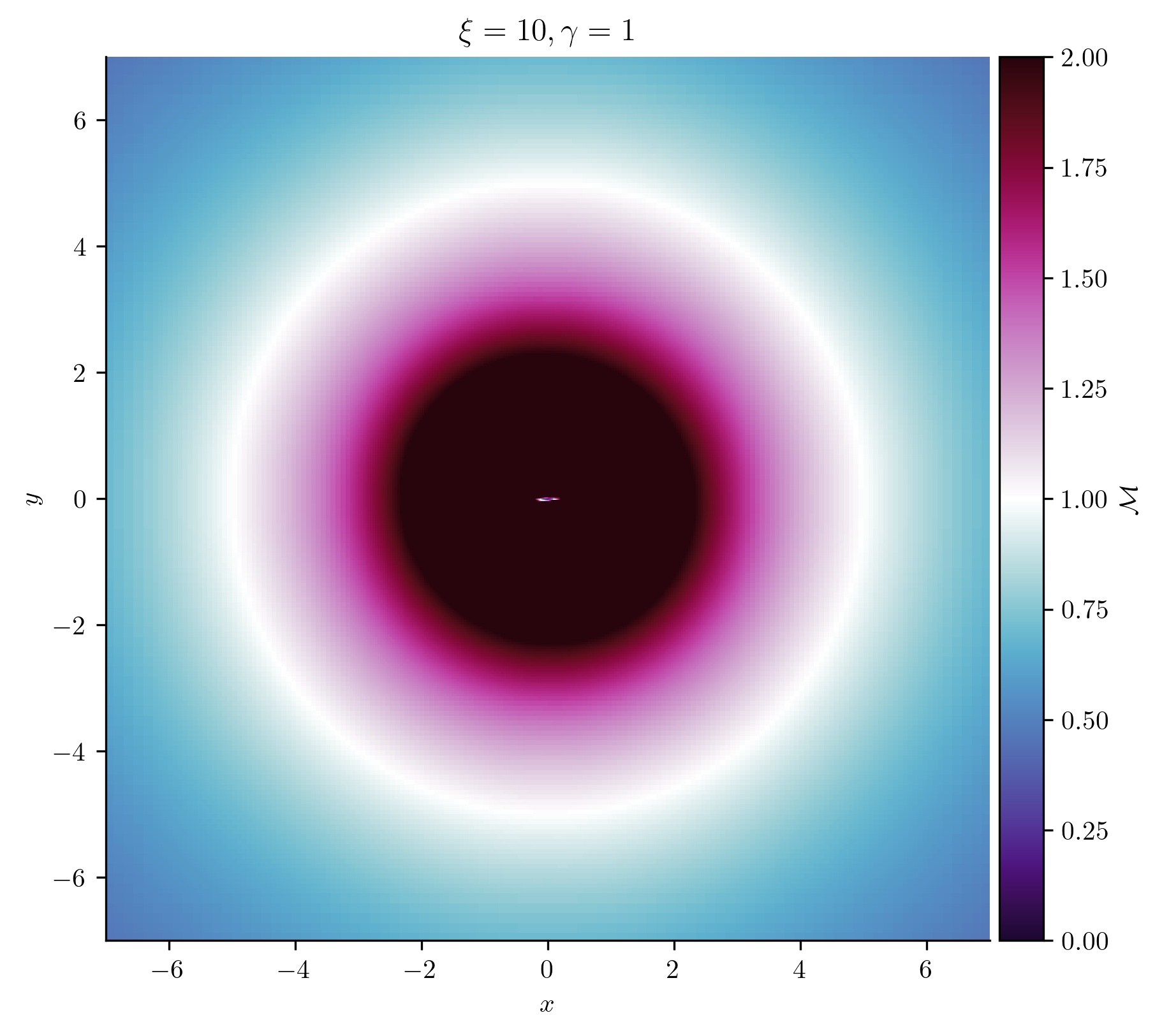
Mach number — spheroidal $\mathcal{M}=1$ surface consistent with $P_2$ deformation
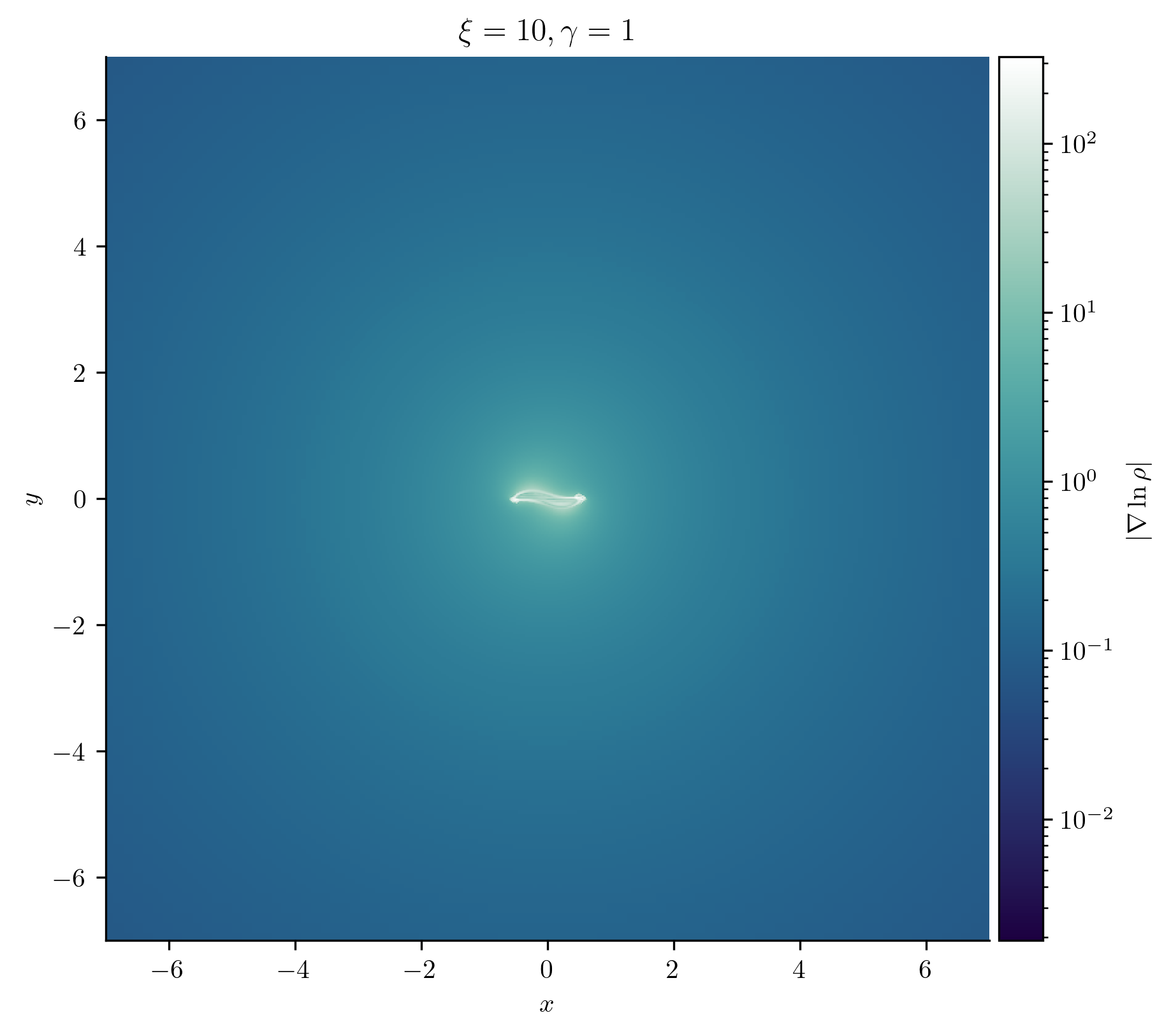
$|\nabla \ln\rho|$ — binary imprint confined to center; nearly spherical at the Bondi scale
Isothermal ($\gamma=1$): homentropic $\Rightarrow$ potential flow exact. No heating, no vorticity.
The Hidden Assumption
Perturbation theory assumes potential flow
$\nabla \times \mathbf{v} = 0 \;\Leftrightarrow\; \nabla s = 0$ (homentropic)
$\gamma = 1$: entropy is trivially uniform — safe
$\gamma > 1$: shocks can form, and shocks generate $\Delta s$
$\nabla s \neq 0 \;\Rightarrow\; \nabla\rho \times \nabla p \neq 0$
$\Rightarrow\;$ baroclinic vorticity generation
$\Rightarrow\;$ turbulence
$\Rightarrow\;$ potential flow breaks down
Isothermal vs. Adiabatic
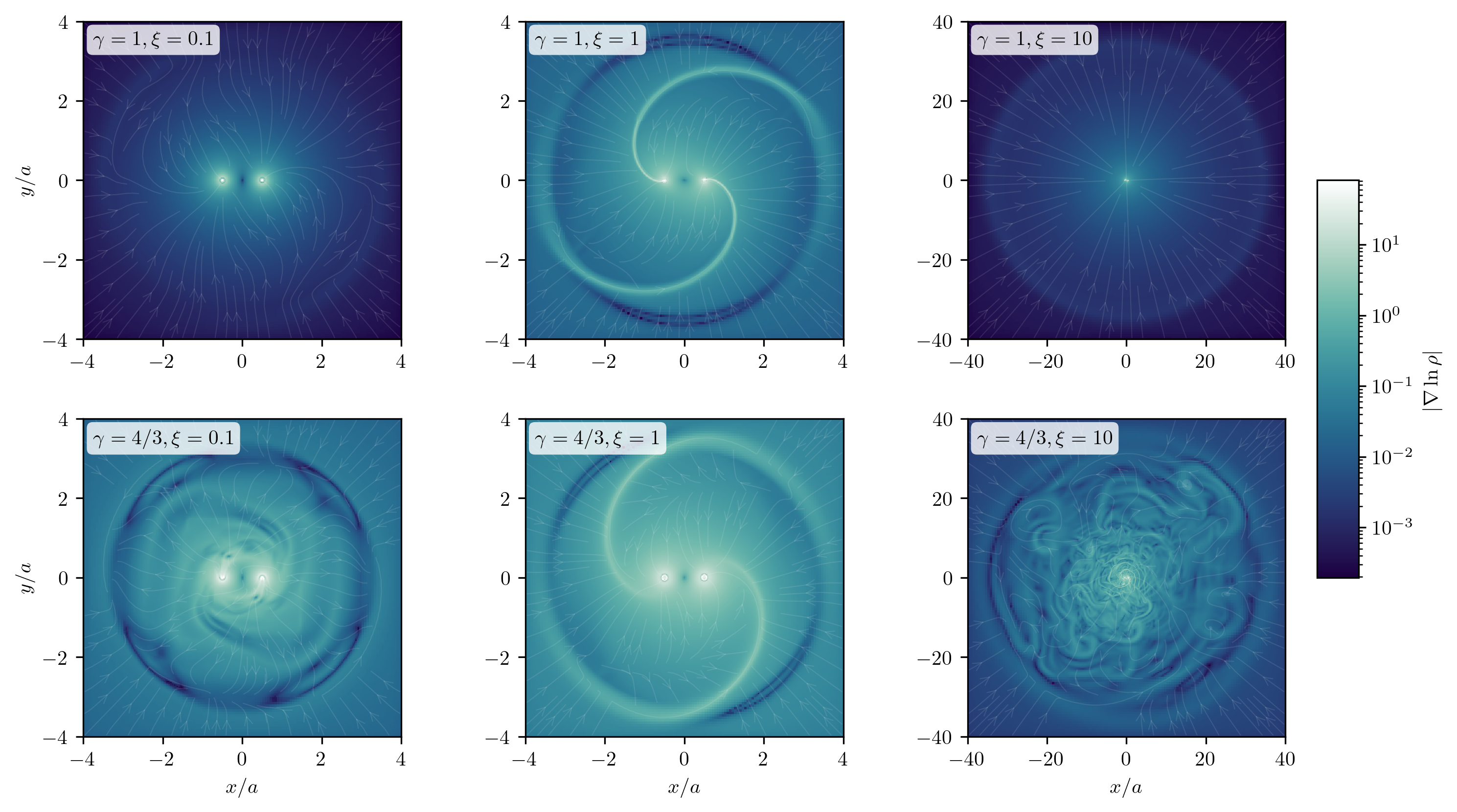
Top ($\gamma=1$): smooth, laminar at all $\xi$
Bottom ($\gamma=4/3$): shocks $\to$ entropy gradients $\to$ turbulence
The perturbative regime ($\xi \gg 1$) is where the adiabatic flow is most turbulent.
Accretion Rate Variability
Power spectra of $\dot{M}(t)$ at $\xi = 10$
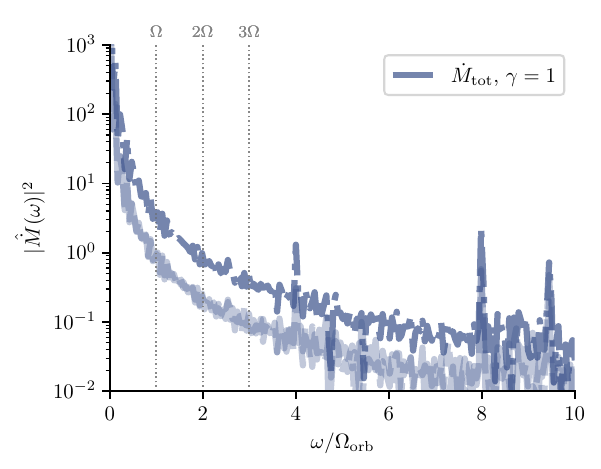
Isothermal ($\gamma = 1$)
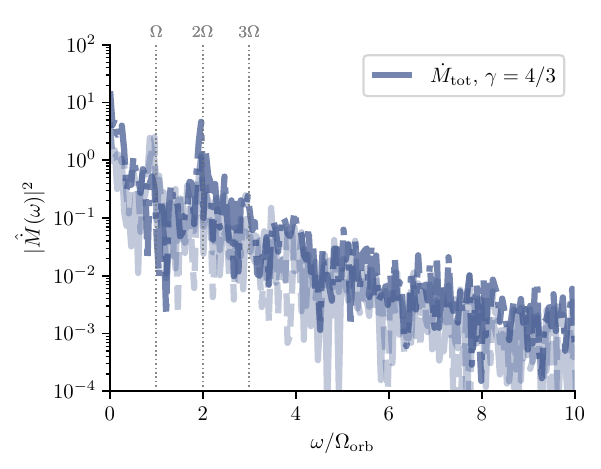
Relativistic ($\gamma = 4/3$)
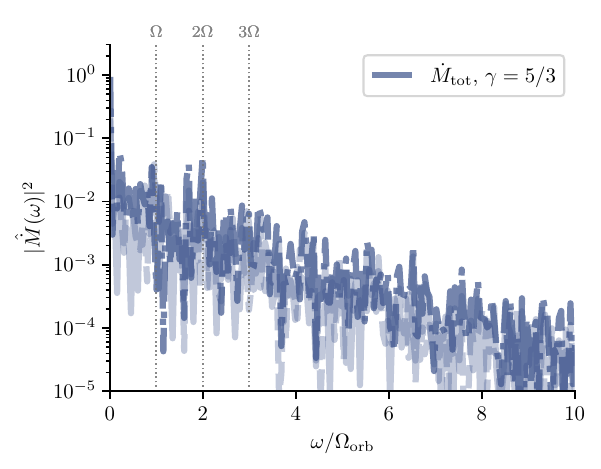
Monatomic ($\gamma = 5/3$)
Isothermal: no spectral signal at $\Omega, 2\Omega, 3\Omega$ — the Bondi sphere does not know it hosts a binary. Adiabatic: broadband turbulent noise.
The Monatomic Gas: $\gamma = 5/3$
Streamlines reveal vortical flow everywhere
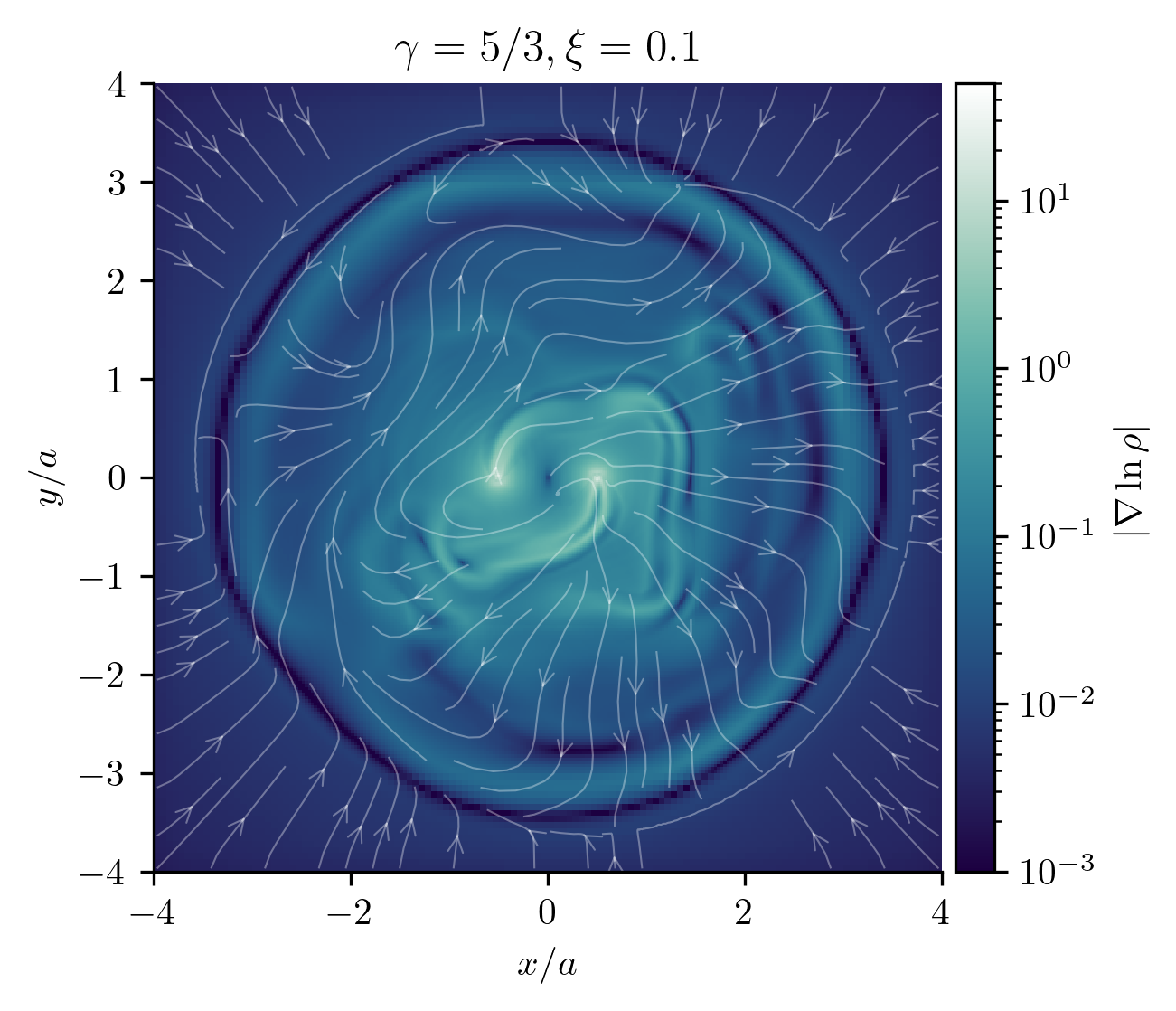
$\xi = 0.1$
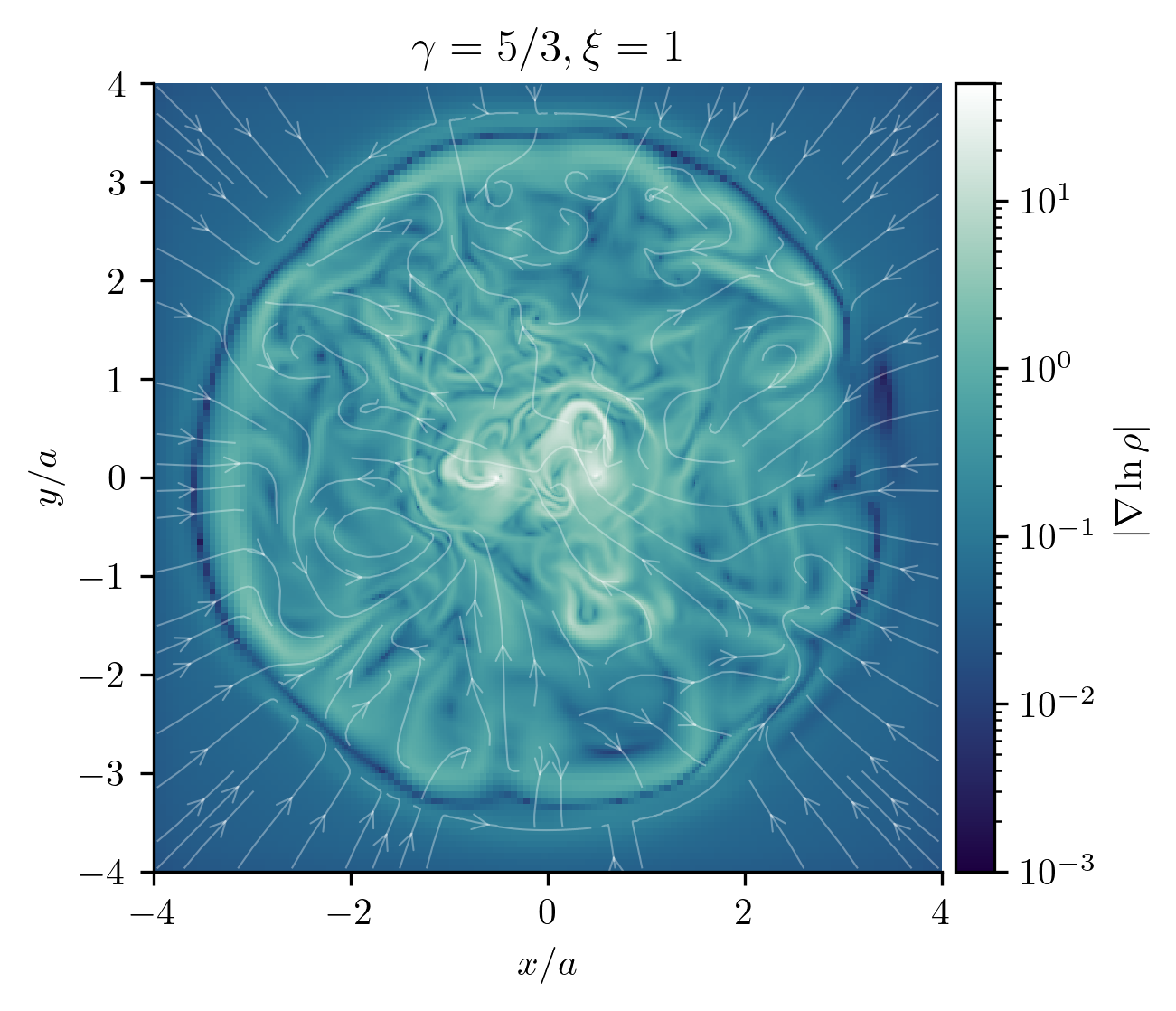
$\xi = 1$
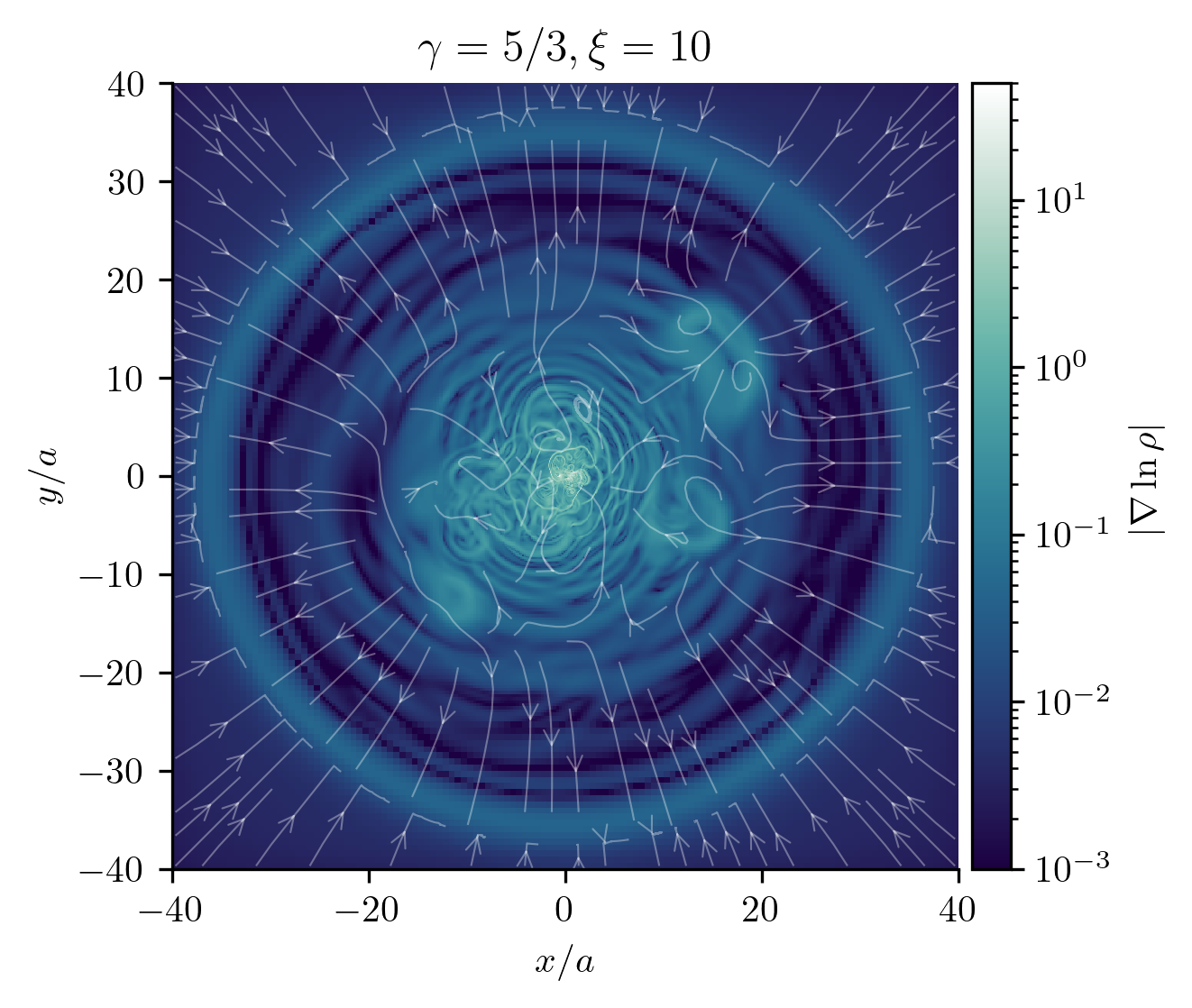
$\xi = 10$
Spiral shocks $\to$ entropy jumps $\to$ baroclinic vorticity $\to$ turbulence. Also $\gamma = 5/3$ has no finite sonic point.
Turbulent Entropy Proxy Spectra
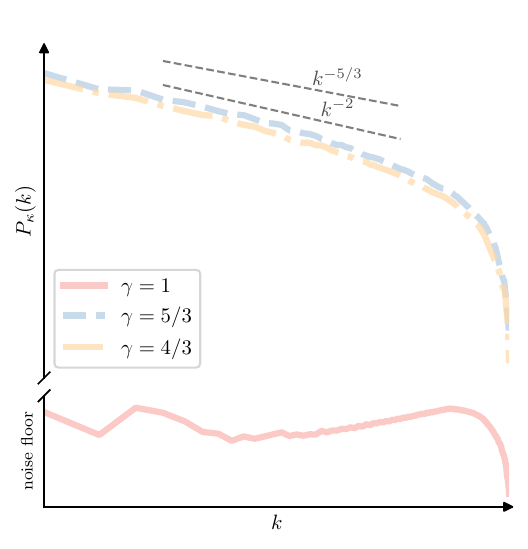
$\gamma = 4/3$ and $\gamma = 5/3$: developed turbulence with $k^{-5/3}$ to $k^{-2}$ scaling
$\gamma = 1$: at the noise floor — no turbulence
Shocks are the engine: they generate entropy gradients, which drive baroclinic vorticity, which cascades into turbulence.
The isothermal EOS is the unique case where the perturbative picture survives.
Accretion Efficiency
$\eta \equiv \dot{M}_{\rm binary} / \dot{M}_{\rm Bondi}$ across all regimes
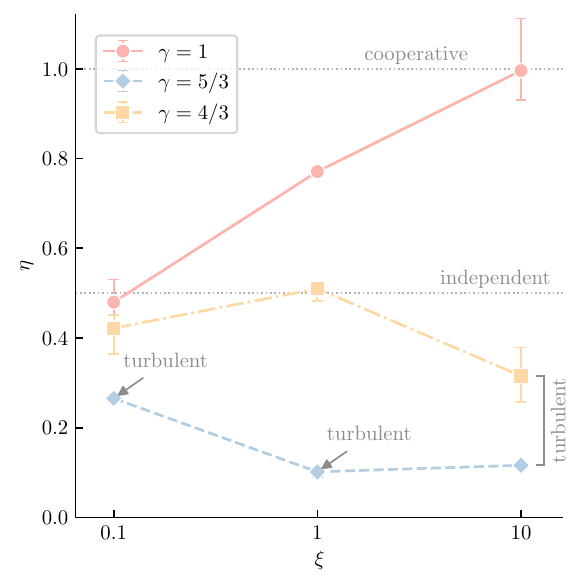
Isothermal ($\gamma = 1$): $\eta$ rises toward cooperative ($\eta = 1$) as $\xi$ grows
Relativistic ($\gamma = 4/3$): $\eta$ drops from $\sim 0.5$ to $\sim 0.3$ at large $\xi$ — turbulence worsens in the perturbative regime
Monatomic ($\gamma = 5/3$): $\eta \sim 0.1$ throughout — strongly suppressed
Perturbation theory predicts $\eta \to 1$ for $\xi \gg 1$. Isothermal gas trends this way, but for $\gamma > 1$ turbulence grows with $\xi$ and suppresses accretion.
Summary
1. Binary deep in its Bondi sphere: expansion parameter $\varepsilon_s = \mu/(2R_s^2) \ll 1$
2. First-order perturbation $\propto P_2(\cos\theta)$ satisfies a master ODE with a regular singular point at $R_s$
3. Regularity at sonic point + decay at $\infty$ $\Rightarrow$ unique solution via Frobenius + matching
4. First-order accretion rate vanishes by $P_2$ orthogonality
5. Leading correction: $\Delta\dot{M}/\dot{M}_{\rm Bondi} \sim \varepsilon_s^2 \sim \mu^2\xi^{-4}$
6. Positive sign: the binary enhances accretion (geometric inequality)
7. Simulations confirm isothermal theory; adiabatic flows develop shocks, entropy gradients, and turbulence